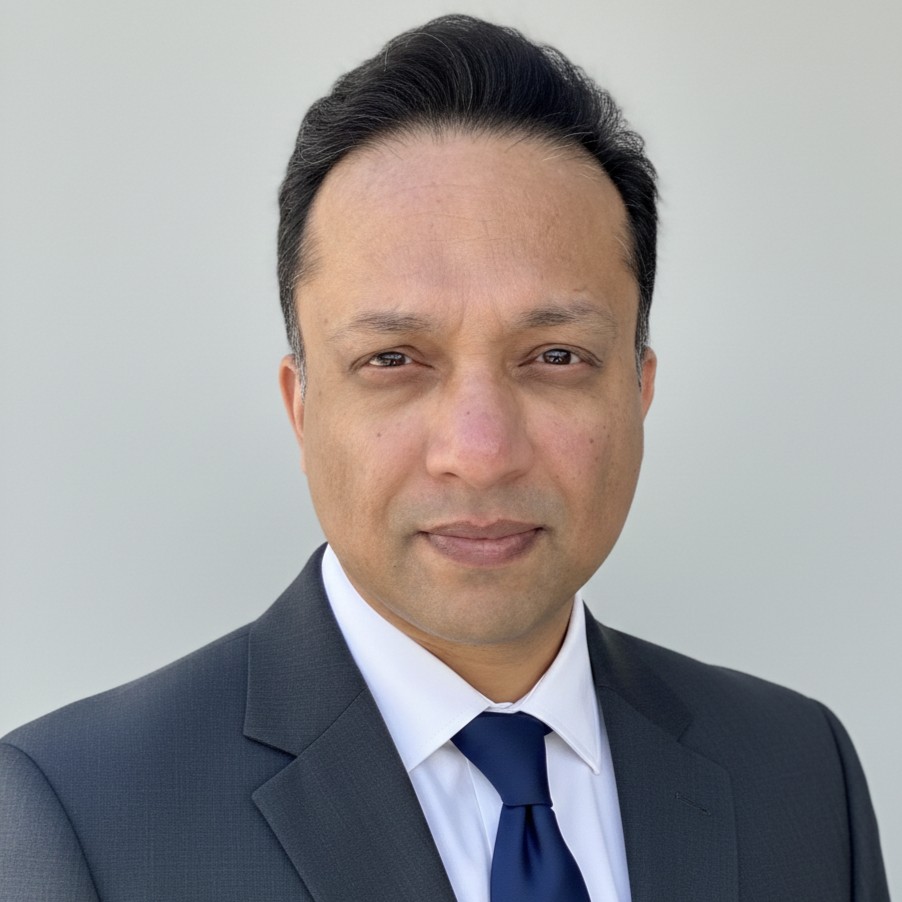
Amitabh Arolkar, CFA, FRM
Founder, Tangency Point Capital
- CFA Charterholder · CFA Institute
- Financial Risk Manager · GARP
- MBA Finance · University of Mumbai
Twenty-five years old, a hedge fund trading book in Dubai, and a front-row seat to one of the great capital misallocations in market history. Watching capital pour into businesses with no earnings, no moats, and no margin of safety, and then watching it evaporate, was the kind of lesson that textbooks describe but markets teach permanently. The implosion of 2000-2002 was not a crisis to survive. It was a curriculum. Price disconnects from value. It always corrects. The only question is whether you are positioned when it does.
Abu Dhabi followed: a year at Union National Bank as a fixed income and equity analyst, where trading instincts gave way to fundamental discipline. Then Bahrain, and for eighteen years, the job was to deploy capital where others would not look, and to protect it when markets stopped making sense. As VP of Proprietary Investments at Bank ABC, that meant running a $3 billion credit and fixed income book alongside a $10 billion HQLA portfolio, through the 2008 crisis, the Arab Spring, the oil collapse of 2014, and the COVID unwind. Five full market cycles. Three continents. One discipline: find the gap between price and value, and hold the conviction to act on it.
Credit analysis, risk architecture, balance sheet forensics: it turns out to be precisely the toolkit that identifies overlooked franchise value before markets can see it. In 2011, a detailed analysis of a small, illiquid US specialty lender revealed a focused, technology-driven model addressing an underserved segment with structural advantages the market had not yet priced. The entry valuation was under $20 million. That institution is now publicly traded with a market capitalisation approaching $1.5 billion. The analysis was right. The institutional constraints of the time made the investment impossible. The lesson was permanent: the gap between recognising value and being positioned to act on it is where most capital fails. TPC is structured so that gap does not exist.
That forensic discipline is exactly what Asia rewards. The companies TPC targets are not undiscovered because they are bad businesses. They are undiscovered because they are complex, illiquid, and require the kind of patient, bottom-up work that sell-side coverage cannot justify and most fund managers will not commit to. That is the edge.
Founded Tangency Point Capital in 2021 to build something different: not a fund seeking AUM, but a small number of permanent capital partnerships with investors who have a multi-year horizon. The thesis begins in Japan. The ambition extends across Asia. The approach (credit discipline married to activist conviction) does not change.